

Why Fuelling Gets Harder as Sessions Get Longer
Short sessions are forgiving. Go out for 45 minutes and your body's glycogen stores will carry you through without any intervention. But push past 60–90 minutes and the equation changes — your stores deplete, your pace drops, and if you've left it too late, no amount of gels will bring you back quickly.
Proper endurance fuelling isn't about eating when you're hungry. It's about maintaining a steady supply of carbohydrate to your working muscles before the deficit sets in. Get it right and you'll finish stronger, recover faster, and train more consistently.
The Core Principle: Carbohydrates Per Hour
The foundation of endurance nutrition is carbohydrate intake per hour. Research consistently shows:
- 30–60g of carbs/hour for sessions up to around 2.5 hours
- Up to 90g of carbs/hour for longer efforts — but only when using a mix of glucose and fructose, which your gut can absorb simultaneously via different transporters
Going above 60g/hour on glucose alone will likely cause GI distress. The 90g ceiling requires a roughly 2:1 glucose-to-fructose ratio, which most modern endurance products are formulated to deliver.
When to Start Fuelling
The most common mistake: waiting until you feel tired or hungry. By then, you're already behind.
A practical timeline:
- 0–45 min: No fuelling needed for most athletes
- 45 min: Take your first gel or begin sipping a carb drink if the session will exceed 90 minutes
- Every 20–30 min thereafter: Continue fuelling at regular intervals to maintain blood glucose
Set a timer if you need to — it's easy to forget when you're focused on effort or pace.
Fuelling by Session Type
Long Runs (90 min+)
Running limits what you can carry and how easily you can eat. Gels are the most practical format.
Always take gels with water — see our guide to
Long Rides (2 hrs+)
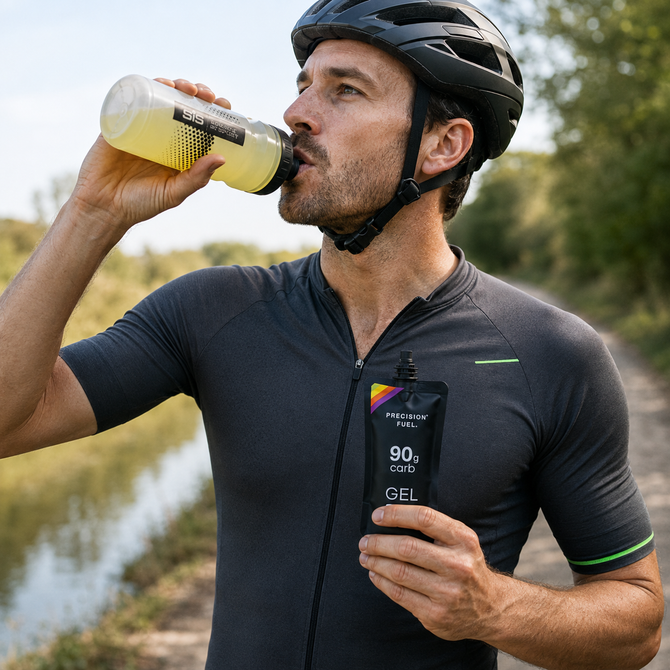
Cycling gives you more options — you can carry more, eat more easily, and use a wider range of formats.
Drink mixes are particularly effective on the bike because they combine hydration and carbohydrate in one bottle, reducing the cognitive load of managing multiple products.
Triathlon and Multi-Sport
Triathlon adds complexity — your fuelling strategy needs to work across swim, bike, and run, with transitions in between.
General principles:
- Swim: No fuelling needed; focus on pre-race carb loading
- Bike: This is your primary fuelling window — use drink mixes and gels aggressively
- Run: Shift to gels only; your gut is under more stress during running
For electrolyte strategy across all three disciplines, see our guide to
Building Your Fuelling Plan
A simple framework for any long session:
- Calculate your target carb intake — session length × carbs/hour target (start at 60g, build towards 90g over time)
- Choose your formats — gels for convenience, drink mix for background fuelling, chews for variety
- Set your intervals — every 20–30 minutes, starting at 45 minutes
- Practise in training — gut training is real; your digestive system adapts to processing carbs during exercise
- Adjust based on conditions — heat increases fluid and electrolyte needs; cold may reduce perceived thirst but not actual need
Common Fuelling Mistakes to Avoid
- Starting too late — by the time you feel it, you're already behind
- Taking gels without water — slows absorption and risks GI distress
- Trying new products on race day — always test in training first
- Ignoring electrolytes — carbs without sodium replacement leads to hyponatraemia risk on very long efforts
- Under-fuelling because of weight concerns — under-fuelling costs you more in performance than the calories save
Key Takeaways
- Start fuelling at 45 minutes, regardless of how you feel
- Target 60g carbs/hour as a baseline; build to 90g for efforts over 2.5 hours
- Match your format to your sport — gels for running, drink mixes for cycling
- Practise your strategy in training before race day
- Combine your fuelling plan with a solid electrolyte strategy for best results