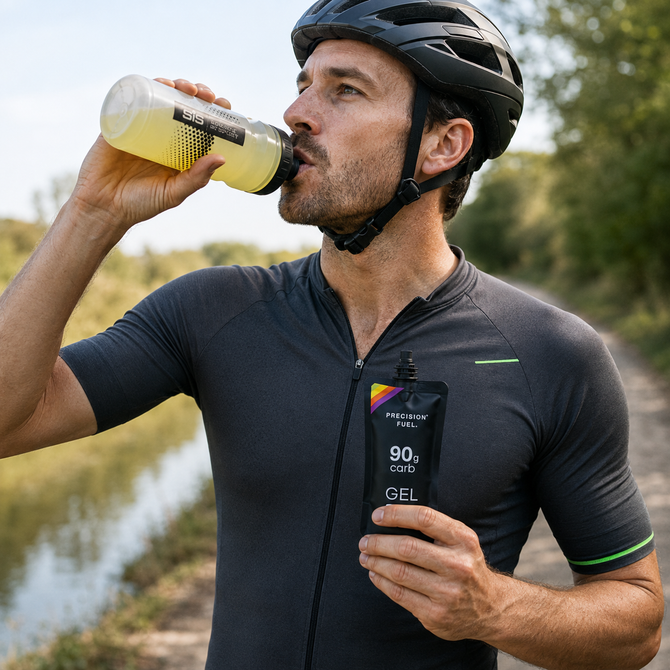



Marathon fuelling is not about waiting until you feel hungry. By then, you are already trying to catch up. A better approach is to start early, take in carbohydrate at regular intervals and practise the plan before race day.
This marathon fuelling plan explains how many gels you may need, when to take them and how to account for carbohydrate from sports drinks. Use it as a starting point, then adjust it to your pace, stomach, weather and the products you have tested in training.
How many gels do you need for a marathon?
There is no single correct number because gels contain different amounts of carbohydrate, and some runners also use sports drinks, chews or carbohydrate mixes. The more useful calculation is:
Target carbohydrate per hour × expected race time = total carbohydrate target.
As a practical starting point, many runners aim for around 40–60g of carbohydrate per hour. Experienced runners who have trained their gut may work towards 60–90g per hour for longer or harder efforts, but that should be introduced gradually and practised well before race day.
- 3-hour marathon: around 120–180g of carbohydrate
- 4-hour marathon: around 160–240g of carbohydrate
- 5-hour marathon: around 200–300g of carbohydrate
Those totals include carbohydrate from every source, not just gels. If your drink provides 30g per hour, you only need to get the remaining 10–30g per hour from gels or other race fuel.
A simple marathon gel schedule
For most runners, taking your first gel early is easier than trying to fuel once fatigue has set in. A sensible starting pattern is:
- Eat your normal pre-race breakfast around two to three hours before the start.
- Take an optional small carbohydrate top-up 10–15 minutes before the gun if you have tested it in training.
- Start taking carbohydrate around 20–30 minutes into the race.
- Continue with a small amount every 25–35 minutes, adjusting the number of servings to the carbohydrate content of each product.
- Keep fuelling late in the race, even if your pace drops. The final 10K is not the time to stop taking in energy.
For example, if you are using gels that contain about 30g each and want 60g per hour, you would need roughly two gel-equivalents per hour. If your gels contain more carbohydrate, you may need fewer. Always check the nutrition information on the pack rather than counting sachets alone.
Marathon fuelling plan for a 3-hour finish
A three-hour runner might begin with a target of 40–60g of carbohydrate per hour. That gives a total of approximately 120–180g across the race.
- Take your first gel at 20–25 minutes.
- Take another gel or carbohydrate serving at roughly 50–60 minutes.
- Continue at 25–35-minute intervals, using your drink to fill part of the carbohydrate target.
- Aim to finish your planned fuel before the final 20–30 minutes, rather than carrying several unused gels to the finish.
If you use 30g gels and get 30g per hour from an on-course drink, five or six gels may cover the remaining requirement. If you are not drinking carbohydrate, you will need more gel carbohydrate to reach the same hourly total.
Marathon fuelling plan for a 4-hour finish
For a four-hour marathon, a 40–60g-per-hour target works out at approximately 160–240g of carbohydrate. Because you are racing for longer, consistency matters even more than a large intake at one point.
- Take the first gel between 20 and 30 minutes.
- Plan another carbohydrate serving every 30 minutes or so.
- Use water with products that require it, and follow the instructions for isotonic gels that are designed to be taken without a separate drink.
- If you use caffeine, save some for the second half rather than taking every serving caffeinated.
A four-hour plan often works well with a mix of regular gels, an electrolyte or carbohydrate drink and one or two caffeine servings. The right balance depends on your tolerance and the race's aid stations.
Marathon fuelling plan for a 5-hour finish
A five-hour marathon requires a plan that is easy to follow when you are tired. At 40–60g per hour, the total target is approximately 200–300g of carbohydrate.
- Set reminders on your watch for every 25–30 minutes.
- Take small, regular servings rather than waiting for a low-energy feeling.
- Use a combination of gels, chews and carbohydrate drink if too many gels become difficult to manage.
- Carry a spare serving in case an aid station is crowded, you drop a gel or your stomach needs a change of texture.
Longer race times do not automatically mean you should force the highest possible carbohydrate intake. Start with a target you can digest comfortably in training and build from there.
Which gels are best for marathon fuelling?
The best gel is the one that gives you useful carbohydrate, agrees with your stomach and is practical to take at race pace. Compare the carbohydrate per serving, caffeine content, texture and whether it needs water.
For higher-carbohydrate options, see the Precision Fuel & Hydration PF 90 Gel. For a more moderate serving, the Precision Fuel & Hydration PF 30 Caffeine Gel can be useful when you want to add caffeine selectively.
Runners who prefer SiS products can compare the SiS BETA Fuel Gel with SiS GO Energy + Caffeine Gels. You can browse the wider Fuel collection to build a combination that suits your race plan.
Should you use caffeine gels?
Caffeine can feel useful late in a marathon, but it is not a substitute for carbohydrate. If you use it, introduce it in training and keep track of the total caffeine you are taking from gels, coffee and other sources.
A simple approach is to use regular gels early, then introduce one caffeine serving around halfway or during the final third of the race. Some runners prefer a second serving later, while others find that one is enough. Do not try a new caffeine strategy for the first time on race day.
What to drink with your gels
Hydration and fuelling work together, but drinking more is not always better. Take small, regular sips according to the weather, your sweat rate and the race guidance. If a gel needs water, take it with water rather than combining it with a very concentrated sports drink.
In warm conditions, you may need more fluid and electrolytes. In cool conditions, you may need less. Avoid copying somebody else's drinking volume without considering your own training experience and the conditions on the day.
Practise your marathon fuelling plan
Your race-day plan should be tested during long runs, not invented at the start line. Practise the same breakfast timing, gel spacing, drink strategy and caffeine approach you intend to use in the marathon.
Keep a note of what you took, when you took it and how your stomach responded. If you feel sick, bloated or unable to take the next serving, reduce the size of each serving, increase the gap slightly and review how concentrated your drink was. If you regularly struggle with fuelling or have a medical condition that affects eating or drinking during exercise, speak to a qualified healthcare professional or sports dietitian.
Marathon fuelling checklist
- Choose a carbohydrate target per hour.
- Check the carbohydrate content of every gel or serving.
- Include carbohydrate from drinks in your calculation.
- Plan your first serving for 20–30 minutes into the race.
- Set watch reminders so you do not rely on hunger.
- Decide which servings, if any, will contain caffeine.
- Carry one spare serving and practise the complete plan on long runs.
The goal is not to take the maximum number of gels. It is to take enough carbohydrate, early and consistently, using products you know you can handle. Build your plan around your finish time, practise it in training and make race day as predictable as possible.