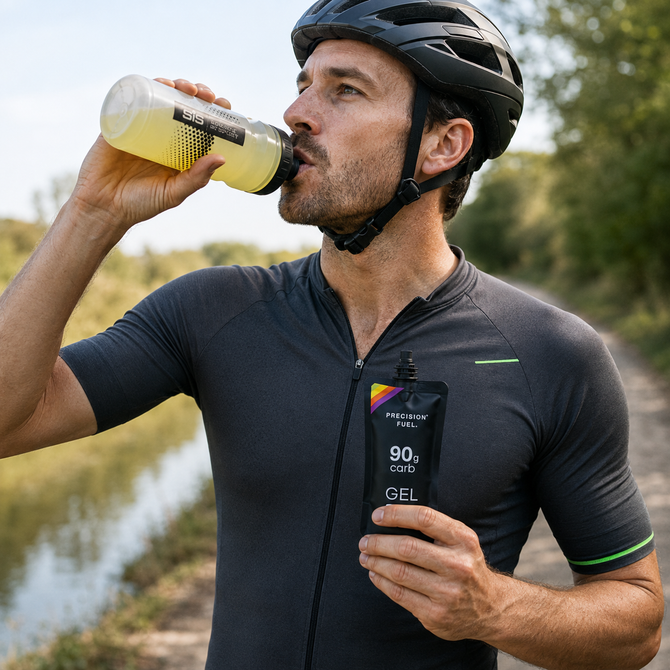


Energy gels and chews can both help you take in carbohydrate during running and cycling, but they suit different moments. Gels are quick, compact and easy to plan. Chews take longer to eat but offer a different texture, more control over portion size and a useful break from liquid or gel fuel.
There is no universal winner. The best race fuel is the format you can digest comfortably, carry easily and take consistently when you are moving.
Energy gels vs chews: the quick answer
- Choose gels when you want fast, compact fuel with minimal chewing.
- Choose chews when you prefer to eat gradually or want a change of texture.
- Choose blocks when you want to split a serving into smaller pieces over time.
- Use a mix when a long session makes one format difficult to tolerate.
Whichever format you choose, compare the carbohydrate per serving. One gel, one chew and one block may contain very different amounts of carbohydrate, so count grams rather than packages.
What are energy gels?
Energy gels are concentrated carbohydrate servings designed to be taken during exercise. They are small, easy to carry and usually faster to consume than solid fuel.
Some gels are designed to be taken with water, while isotonic products may be formulated to be taken without a separate drink. Always follow the instructions for the product you are using, particularly when you are also drinking a concentrated sports drink.
Gels are particularly useful when:
- you want a simple race plan with regular timed servings
- you are running and do not want to chew while holding pace
- you need a compact fuel that fits easily in a pocket or belt
- you want to use caffeine selectively
Explore options such as the Precision Fuel & Hydration PF 90 Gel, Precision Fuel & Hydration PF 30 Caffeine Gel or SiS BETA Fuel Gel.
What are energy chews?
Energy chews are soft, bite-sized carbohydrate products that you eat during exercise. They can feel more like food than a gel and are often easier to divide into smaller portions.
Chews are useful when:
- you prefer to eat rather than swallow a gel
- you want to take a little carbohydrate at a time
- you need a texture change during a long ride or run
- you want to avoid taking every serving as a liquid or gel
Options include the Precision Fuel & Hydration PF 30 Chew, the higher-carbohydrate Precision Fuel & Hydration PF 60 Chew and SiS BETA Fuel Energy Chews.
Gels vs chews for running
Gels are often the simplest choice for running because they can be taken quickly without changing your stride. They also make it easy to set a watch reminder and follow a repeatable plan.
Chews can be a better fit if you dislike the texture of gels, find constant sweetness tiring or want to spread one serving over several minutes. The trade-off is that chewing takes more time and may be awkward during a fast race or a crowded section of the course.
For a half marathon, a runner might use one or two gels, a small pack of chews or a combination. For a marathon or longer run, mixing formats can make the plan easier to follow. Our guide to how many gels you need for a half marathon explains how to plan servings by finish time.
Gels vs chews for cycling
Cycling gives you more opportunities to eat, particularly on steady roads or climbs, so chews can be easier to use than they are while running. You can take one piece at a time, put the packet away and continue riding.
Gels still have a place on the bike. They are useful during hard efforts, climbs, time trials or any section where you do not want to chew. A gel can also be easier to take when you are already carrying bottles and do not want to add much solid food.
For longer rides, many cyclists use a combination of drinks, gels, chews and ordinary food. The more varied the session, the more important it is to know the carbohydrate total of each serving rather than relying on appetite.
Which gives you more carbohydrate?
Neither gels nor chews automatically provide more carbohydrate. It depends on the product and serving size. Check:
- carbohydrate per gel or piece
- how many pieces make up one serving
- whether the pack can be resealed
- how much water the product requires
- whether it includes caffeine or electrolytes
If your target is 40–60g of carbohydrate per hour, build a plan around that target and then choose the most practical combination. For longer or harder efforts, experienced athletes may work towards more, but increase intake gradually and practise it first.
Are chews easier on your stomach than gels?
Some people find chews easier to tolerate because they can eat them slowly. Others prefer gels because they are quick and do not leave them chewing while running. Stomach comfort is individual and can also be affected by pace, heat, concentration, hydration and what you ate beforehand.
If a gel feels too concentrated, try a product intended to be taken with water, reduce the size of each serving or switch to chews for part of the session. If chews feel heavy, use smaller pieces more often or return to a gel-and-drink combination.
What about energy blocks?
Energy blocks sit between gels and chews. They are solid, bite-sized pieces that can be divided over time, making them useful when you want more control than a single gel provides.
The Luchos Energy Blocks are one option for riders and runners who prefer a solid format. Blocks can be especially practical on long rides, where you have time to eat gradually, but they still need to be tested at race pace.
Can you combine gels and chews?
Yes. Combining formats can make a long session more manageable, as long as you keep track of the total carbohydrate and any caffeine.
A simple mixed plan might use a regular gel early, chews during the middle of the session and a caffeine gel later if you have tested it. On a long ride, you could use a carbohydrate drink alongside chews and keep a gel for a hard climb.
Do not add formats just for variety without checking the total. A gel, several chews and a carbohydrate drink can quickly take you above the amount you have trained your gut to handle.
How to choose between gels and chews
Choose gels if you want:
- the fastest, simplest way to take a planned serving
- minimal chewing during a hard effort
- compact fuel for a race belt or pocket
- an easy way to add a measured caffeine serving
Choose chews if you want:
- to eat smaller amounts over several minutes
- a different texture during a long session
- solid fuel that feels more like food
- more flexibility with portion size
Choose blocks if you want:
- small pieces that are easy to split
- a solid option for long rides and endurance sessions
- more control over how quickly you eat a serving
Practise your fuel choice before race day
Test the exact products during training, including the flavour, texture, packet opening and water strategy. Practise taking them at the same pace and time you expect to use them in your event.
Keep a note of how much carbohydrate you took, when you took it and how your stomach responded. If you are regularly unable to fuel comfortably, reduce the serving size, increase the spacing and review your drink concentration. If you have a medical condition that affects eating or drinking during exercise, speak to a qualified healthcare professional or sports dietitian.
Gels vs chews checklist
- Check the carbohydrate per serving.
- Decide whether you prefer fast fuel or gradual eating.
- Check whether water is required.
- Account for caffeine and carbohydrate from drinks.
- Choose formats that suit running, cycling or both.
- Practise the complete plan before race day.
The best race fuel is not the product with the biggest promise. It is the one you can carry, digest and take consistently when the session gets hard. Start with a simple plan, test it in training and use the format that helps you keep fuelling.